

South Korea Telecommunications Services Market Growth Driven by SK Telecom, KT, LG Uplus
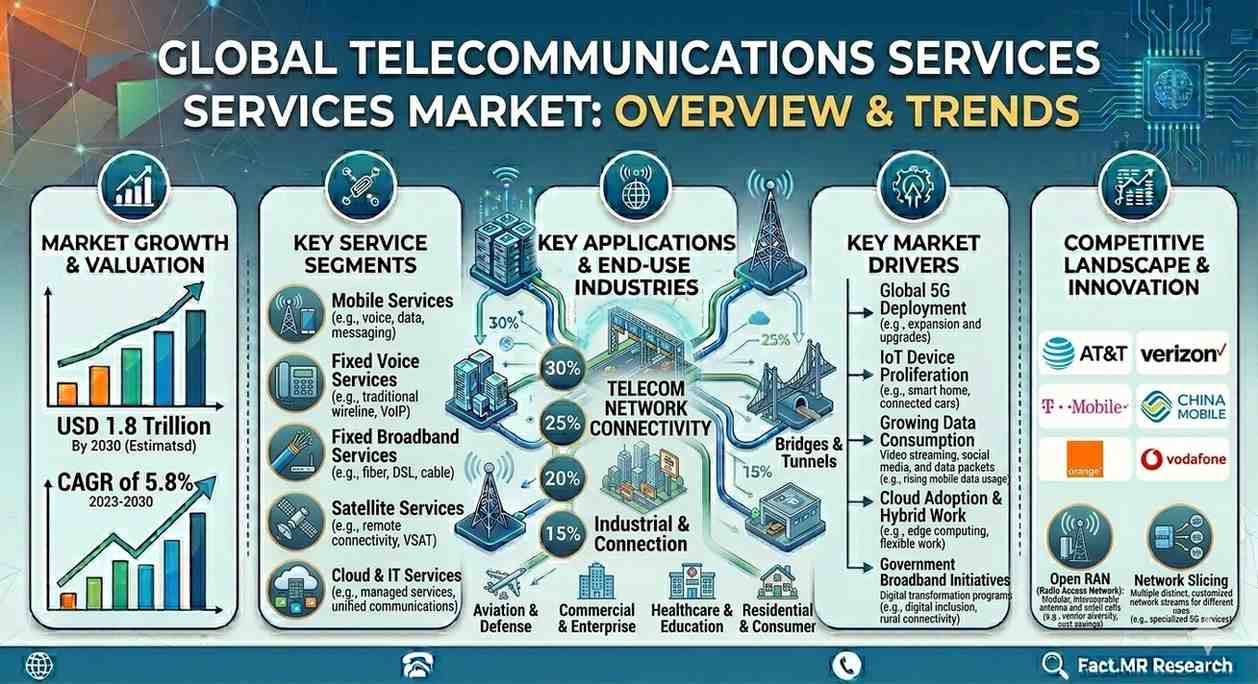
Telecommunications Services
South Korea Telecommunications Services Market expands with enterprise 5G and digital connectivity
ROCKVILLE, MD, UNITED STATES, April 15, 2026 /EINPresswire.com/ -- According to Fact.MR’s latest analysis, the South Korea telecommunications services market continues to evolve as a highly advanced, 5G-driven digital infrastructure ecosystem, supporting enterprise transformation and next-generation connectivity.Global market valued at USD 2,251.2 billion in 2025
Expanding alongside strong 5G adoption and enterprise demand
South Korea projected to grow at a CAGR of 5.8% (2026–2036)
Driven by increasing enterprise private network deployment and digital services demand
The market is transitioning from consumer voice and data services to enterprise-grade connectivity solutions, including private 5G, IoT networks, and low-latency applications.
Get detailed market forecasts, competitive benchmarking, and pricing trends:
https://www.factmr.com/connectus/sample?flag=S&rep_id=14532
Quick Stats
Market Size (2025 - Global): USD 2,251.2 billion
Market Growth (South Korea): 5.8% CAGR (2026–2036)
Leading Segment: Mobile telecom services (64% share)
Leading End User: BFSI sector (24% share)
Key Growth Area: Enterprise private 5G networks
Leading Region: Asia Pacific
Key Players: SK Telecom, KT Corporation, LG Uplus, Verizon, AT&T
Executive Insight for Decision Makers
South Korea’s telecom market is shifting toward enterprise-centric revenue models.
Strategic Shift: Operators are moving from mass-market consumer services to high-value enterprise connectivity and digital platforms
What Stakeholders Must Do:
Expand private 5G network capabilities for industries
Invest in cloud, edge computing, and IoT integration
Strengthen cybersecurity and low-latency service offerings
Risk of Inaction: Telecom operators risk ARPU stagnation and loss of enterprise clients to more advanced service providers
Market Dynamics
Key Growth Drivers
Nationwide 5G rollout and upgrade to advanced 5G architectures
Rising demand for enterprise connectivity and private networks
Expansion of digital economy sectors (BFSI, e-commerce, IT)
Government-backed initiatives like 5G+ Industry Convergence Programme
Key Restraints
Pricing pressure in consumer mobile services
High capital expenditure for network upgrades
Regulatory and cybersecurity compliance requirements
Emerging Trends
Rapid growth of private 5G networks across industries
Integration of IoT and edge computing with telecom infrastructure
Increasing demand for low-latency, ultra-reliable connectivity
Transition toward 5G-Advanced and future 6G development
Segment Analysis
Leading Segment: Mobile telecom services hold 64% share (2026)
Driven by high smartphone penetration and 5G upgrades
Fastest-Growing Segment: Enterprise connectivity services
Particularly strong in BFSI, healthcare, and IT sectors
Breakdown
By Type: Mobile services, fixed broadband, enterprise networks
By End Use: BFSI, healthcare, IT & e-commerce, government
By Technology: 5G, fibre broadband, IoT connectivity
Strategic Importance:
Enterprise 5G services are emerging as the primary revenue growth engine, offering higher margins than traditional consumer services.
Supply Chain Analysis (Critical Insight)
Value Chain Structure
Infrastructure Providers
Network equipment, spectrum, fibre infrastructure
Telecom Operators
SK Telecom, KT Corporation, LG Uplus
Technology & Platform Providers
Cloud, edge computing, and IoT platforms
Service Integrators & Distributors
Enterprise solution providers and system integrators
End Users
Enterprises (BFSI, healthcare, manufacturing)
Consumers (mobile and broadband users)
Who Supplies Whom
Infrastructure vendors → Telecom operators (network deployment)
Telecom operators → Enterprises & consumers (connectivity services)
Operators + tech providers → Enterprises (integrated digital solutions)
Key Insight:
Telecom operators are evolving into digital service providers, combining connectivity with cloud and data services.
Pricing Trends
Dual Pricing Model:
Competitive pricing in consumer mobile services
Premium pricing in enterprise and private network services
Key Influencing Factors:
Spectrum acquisition costs
Network infrastructure investment
Enterprise service customization
Margin Insights:
Higher margins in enterprise and managed services
Lower margins in consumer broadband due to competition
Regional Analysis (South Korea Focus with Global Context)
Top Countries by CAGR
India – 8.5%
China – 7.1%
United States – 6.4%
South Korea – 5.8%
Germany – 5.0%
South Korea Growth Drivers
Early adoption and leadership in 5G technology
Strong government support for enterprise network deployment
High demand for low-latency, high-speed connectivity
Developed vs Emerging Markets
South Korea & US: High ARPU, enterprise-driven growth
India & China: Subscriber-driven, volume expansion
Competitive Landscape
Market Structure: Highly competitive but concentrated among major operators
Key Players
SK Telecom
KT Corporation
LG Uplus
Verizon Communications
AT&T
China Mobile
Vodafone Group
Deutsche Telekom
Competitive Strategies
Expansion of private 5G and enterprise services
Investment in network quality and coverage
Integration of cloud and digital platforms
Strategic partnerships with enterprise clients
Strategic Takeaways
For Telecom Operators
Focus on enterprise revenue streams and digital services
Invest in next-generation network infrastructure
For Investors
Strong opportunities in 5G, IoT, and enterprise connectivity segments
Prioritize companies with diversified service portfolios
For Marketers & Distributors
Highlight low latency, reliability, and scalability
Target enterprise verticals with customized solutions
Future Outlook
South Korea’s telecom market is set to remain a global benchmark for advanced connectivity.
Transition toward 5G-Advanced and early 6G ecosystems
Expansion of AI-driven network optimization
Growth of industry-specific private network solutions
Long-term growth will be driven by digital transformation across industries and continuous innovation in telecom technologies.
Conclusion
The South Korea telecommunications services market is evolving into a high-value, enterprise-centric digital infrastructure ecosystem.
As demand shifts toward advanced connectivity and integrated digital solutions, telecom operators must innovate beyond traditional services. Those that successfully adapt will secure long-term growth and leadership in the next-generation telecom landscape.
Why This Market Matters
South Korea stands at the forefront of global telecom innovation, with its leadership in 5G and digital infrastructure shaping the future of connectivity. The market’s transformation highlights the critical role of telecom services as the backbone of modern digital economies.
Full Report: Unlock 360° insights for strategic decision making and investment planning-
https://www.factmr.com/checkout/14532
To View Related Report:
5G Services Market https://www.factmr.com/report/5g-services-market
Managed Services Market https://www.factmr.com/report/managed-services-market
Internet Services Market https://www.factmr.com/report/internet-services-market
Biometric Services Platform (BioSP) Market https://www.factmr.com/report/1880/biometric-services-platform-market
S. N. Jha
Fact.MR
+1 628-251-1583
email us here
Legal Disclaimer:
EIN Presswire provides this news content "as is" without warranty of any kind. We do not accept any responsibility or liability for the accuracy, content, images, videos, licenses, completeness, legality, or reliability of the information contained in this article. If you have any complaints or copyright issues related to this article, kindly contact the author above.
